
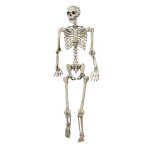

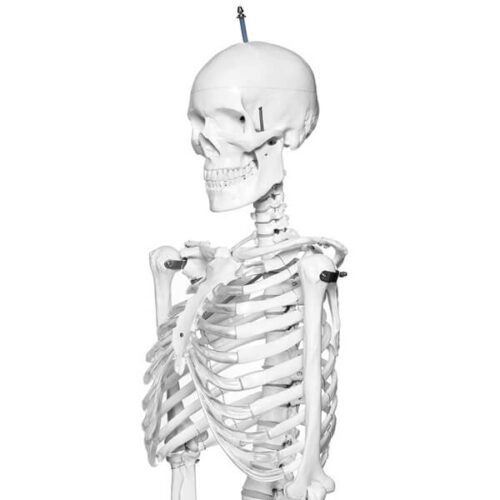
Human Skeleton Model Life Size 60 Inch – 5 Feet Plastic Skeleton for Biological training and education. Usage at School, college laboratory & nursing institute, Types: Fiber Glass, Size: 60 inches, Material: Plastic, Height: 5 Feet, Weight: 5 Kg (Approx), Made in India. Labtex Bangladesh is a seller and supplier of Human skeletons in Bangladesh.
A human skeleton model is a physical or digital representation of the bones that make up the human skeletal system. It serves as a tool for education, research, or medical demonstration. The human skeleton consists of 206 bones in adults, and it plays a crucial role in providing structure, protecting internal organs, and enabling movement.
Key Features of a Human Skeleton Model:
- Axial Skeleton: The central part of the skeleton, including:
- Skull: Protects the brain and supports the structures of the face.
- Vertebral Column (Spine): Composed of 33 vertebrae that protect the spinal cord and support the body’s weight.
- Rib Cage: Includes the ribs and sternum, protecting the heart and lungs.
- Appendicular Skeleton: The limbs and girdles attached to the axial skeleton:
- Shoulder Girdle: Includes the clavicles (collarbones) and scapulae (shoulder blades).
- Upper Limbs: Includes the humerus (upper arm bone), radius and ulna (forearm bones), and bones of the hands.
- Pelvic Girdle: Made up of the hip bones, supporting the attachment of the lower limbs.
- Lower Limbs: Includes the femur (thigh bone), tibia and fibula (leg bones), and bones of the feet.
Components Highlighted in a Human Skeleton Model:
- Joints: Illustrates articulations between bones like the knee, hip, and shoulder.
- Cartilage: Represented in areas like the nose, ears, and joints where cartilage helps cushion and provide flexibility.
- Ligaments and Tendons: Some models show or describe connective tissues that attach bones to muscles or other bones.
Uses of Human Skeleton Models:
- Educational Purposes: Widely used in medical schools, biology classes, and anatomy courses to teach bone structure and human anatomy.
- Medical Demonstrations: Doctors and physical therapists use them to explain skeletal problems, fractures, or surgical procedures.
- Art and Design: Artists studying human proportions and movements often use skeleton models to understand body mechanics.
Types of Models:
- Life-size Models: These are full-size replicas of the human skeleton, providing a realistic scale.
- Miniature Models: Scaled-down versions used for convenience in smaller spaces or for detailed study.
- Disarticulated Models: Consist of individual bones separated to allow closer examination.
- Articulated Models: The bones are connected by flexible joints, allowing movement to demonstrate how the skeleton functions during motion.